
AI in Marketing: Bridging Personalization and Automation
Marketing is undergoing rapid changes thanks to AI. It’s enabling marketers to scale their efforts while helping them meet the growing demand for personalized experiences. Using AI, businesses can develop content that feels personal to each customer and automated repetitive tasks to free up time for real work.
However, with AI technology growing, it has become an essential weapon in the creation of more efficient marketing strategies. Gartner predicts that by 2025, 75% of companies will move from testing AI to using it as part of their day to day operations. This shift will mean new opportunities for growth and greater customer engagement.
In this blog, we’ll see how AI combines personalization and automation, enabling marketers to enhance customer experience while saving time.
- Understanding AI in Marketing:
AI is transforming marketing by combining two crucial elements: personalization and automation. Used together, these technologies combine to become a powerful marketing engine that powers customer experience at scale, increases engagement and drives sales.
The Power of AI in Personalization and Automation
One of AI’s strongest features is personalization. Amazon is a great example. For example, if you’ve ever purchased something from the company or browsed it before, the company uses AI to recommend products. Amazon displays each customer item that the person is more likely to buy, and the shopping feels personalized. By using data to create custom experiences, AI frees the user from the need for manual input and increases engagement and sales.
On the other hand, automation saves businesses time by doing tasks like email marketing or ad management. AI is used by the email marketing platform mailchimp to sort email lists automatically and send messages that are specifically intended for behavior of the customer. Say a person leaves the cart, Mailchimp can automatically send a reminder email to remind them to finish their purchase. This process doesn’t require constant oversight and allows marketers to focus on more strategic tasks.
Combining Personalization and Automation
The real power of AI is when these two elements work together. For example, Spotify uses AI for suggesting songs that other people, with the same tastes, are also listening to. Millions of users get this personalized experience automated, so that the platform stays relevant and entertaining. Like that, marketers can also leverage AI to automate personalized emails, retargeting ads, and other kinds of communication and keep the experience relevant for each user.
According to a study by Epsilon, 80 percent of consumers are more likely to buy from brands who provide personalized experiences. With AI, the business can scale its efforts without decreasing the quality of the experience, because AI can handle both personalization and automation.
- AI-Powered Personalization: How AI Tailors the Marketing Journey
Brands are starting to use AI to create personalized experiences with customers — ones that feel uniquely tailored to each unique shopper. The real power of AI comes from having access to huge volumes of data to predict the content, products or services that will speak to each customer in a way that’s both relevant and impactful. We’ll dig into how AI does this, and how marketers can use AI to generate results.
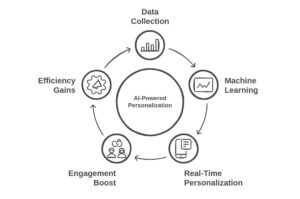
- Machine Learning and Predictive Analytics
Machine learning is at the core of AI driven personalization and enables AI systems to learn from data as time goes by and keep improving. For instance, when Netflix recommends shows and movies based on your viewing history, or other users of a similar viewing history. By doing so, the users are engaged, they are made to watch more content, as the feeling of being watched is a personal one. Shopify too uses predictive analytics that predicts what products customers might purchase next for e-commerce operations. It uses past behaviors to recommend what the right inventory will be for the business, keeping them focused on what their customers need.
- Natural Language Processing (NLP) and Real-Time Personalization
Natural language processing (NLP) is another crucial element of AI driven personalization. One of the goals of NLP is to make it feel natural and personalized for human to AI interaction. An example of this is H&M’s chatbot with NLP, which allows customers to find clothing according to their preferences and sizes, in real time, helping them to shop. Moreover, AI makes for real time personalization across all touchpoints from emails to social media ads to websites, keeping content always relevant to an individual’s current interests and behaviors.
According to McKinsey research, personalized marketing can improve effectiveness by up to 5% to 15%. AI’s capability to personalize at scale gives marketers the means to connect with their audiences on a meaningful level without burdening their teams. Using a combination of machine learning, NLP and predictive analytics marketers can save time and money while delivering highly personalized experience.
Web personalization platforms then scale AI driven personalization all the way up, customizing the user experience on the fly based on unique user behaviors and preferences. AI technology such as machine learning, predictive analytics and natural language processing will enable businesses to create a dynamic, highly personalized journey for every visitor on a company’s website.
For example, if a visitor looks at a product category he is interested in, AI can display more of these products or even offer special promotions related to his browsing behavior. With AI, you can display a reminder or give a discount if they leave their shopping cart. The big advantage is that all these changes occur automatically, and offer a personalized experience that changes with the way the user interacts with the site.
- The Role of Automation in Marketing
Marketing automation enables businesses to reduce repetitive tasks and to present personalized experiences across multiple channels. Through automation they can automate processes such as audience segmentation, content tailoring, and personalized ads to create seamless customer journeys on a scale that businesses can deliver a consistent and relevant experience for each individual.
This is taken a step further by automation powered by AI. Rather than manually adjusting content or target, AI adjusts landing pages and ads dynamically across the board, resulting in a much more efficient and relevant process. It enables businesses to get their message to their audience at the right time, in the right place, with the right message.
How AI Enhances Automation
AI does not only accelerate traditional automation; it makes it smarter. Integration of AI allows businesses to ensure that their automation tools are working more efficiently, for example, by adjusting every time to the behaviour of each customer. It leads to a highly personalized, seamless experience for the customer, and better engagement means higher conversion rates.
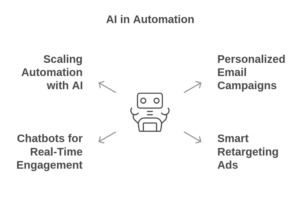
- Personalizing Email Campaigns
One of the best things about AI is that it can personalize emails for you. It uses information related to customer past interactions, purchase history, and browsing behaviour. Based on this, it then sends personalized emails that will connect with every customer.
In fact, for example, an e-commerce site can use AI to identify its customers and classify them by their shopping behavior. If you buy a lot of sports equipment, you might get emails about new arrivals in that category. A customer who had purchased winter clothing the year before could get offers for a winter sale while a customer who had purchased winter clothing the year before could receive offers for a winter sale. These kinds of personalized emails yield higher engagement and better conversion rates.
- Smart Retargeting Ads
Retargeting ads become smarter with AI. It monitors customer behaviour, like what pages they’ve visited or what they’ve put in their cart. This is based on which AI automatically shows ads for products the customer is most likely to buy.
For example, if a customer sees a product and does not purchase it, AI can display an ad for that product, or something similar. It can also provide a special discount to help the customer to complete the purchase. Marketers don’t have to change ads manually because AI takes care of the targeting.
- Chatbots for Real-Time Engagement
Drift uses an AI-powered chatbot that engages visitors in real time. The bot answers questions, qualifies leads and recommends products, all with no human help. Using AI, it responds according to the visitor’s behavior.
For instance, if somebody is on a product’s page, the chatbot might try and provide more product info to the user, responding to asked questions, suggesting similar items and so on. This level of personalization smooths out the interaction and adds engagement as it converts leads into customers. With this chatbot working 24/7, businesses can work more efficiently, and customers can have the help they need anytime they want.
- Scaling Automation with AI
Businesses can scale automation without losing a personal touch with AI. It tailors the experience with each customer’s behavior and preferences to keep the experience fresh. Marketers don’t have to spend more time — AI continuously refines campaigns, continuously making campaigns better and better for engagement and conversion.
Take for example how an AI system can customize an email campaign based on how customers respond to the email. This allows you to change the subject line or send follow up messages automatically, for a campaign that is relevant and still effective.
Conclusion
Marketing is becoming more personalized thanks to AI and simultaneously is made easier through automation. However, it enables businesses to automate the work and save time on repetitive work so the content delivered feels personal. With this, AI provides marketers with tools to understand their audience better and increase engagement. With AI progressing further ahead, there will be a deeper insight and beginning of new technologies in marketing. It’s predicted that the global AI market will boom 36.6 percent every year from 2024 to 2030.
In order to advance, businesses should use AI-powered tools that enhance efficiency as well as customer satisfaction.
Author Bio:

Vidhatanand is the Founder and CEO of Fragmatic, a web personalization platform for B2B businesses. He specializes in advancing AI-driven personalization and is passionate about creating technologies that help businesses deliver meaningful digital experiences.

Leave a Reply